
⚡ What Are Layer 2 Solutions? A Guide to Blockchain Scaling
What are Layer 2 solutions in crypto? Learn how rollups, sidechains, and scaling technologies improve blockchain speed and reduce transaction fees.
The Throughput Problem That Could Not Be Ignored
In the summer of 2021, at the height of the NFT boom, average transaction fees on Ethereum briefly surpassed $60. Simple token transfers that should cost cents were consuming tens of dollars. Complex interactions with DeFi protocols ran into hundreds. For retail participants, this was frustrating. For institutions attempting to build serious financial infrastructure on top of Ethereum, it was disqualifying.
This was not an edge case or a temporary spike — it was the structural consequence of a fundamental architectural decision. Ethereum, like Bitcoin before it, was designed with decentralization and security as its primary constraints. Speed was always a secondary consideration, and as global demand for block space grew, that trade-off became impossible to ignore.
The trilemma at the heart of public blockchain design holds that a network can optimize for at most two of three properties: decentralization, security, and scalability. Ethereum's designers chose the first two. The scaling problem — what the industry now refers to as the "throughput ceiling" — was not a bug. It was the predictable result of engineering choices made in the name of trustlessness.
Layer 2 networks emerged as the canonical answer to this problem. Not by redesigning the base layer — a process so politically and technically complex that it took years and billions of dollars of coordination — but by building a secondary settlement architecture on top of it. For investors, developers, and institutions tracking the maturation of on-chain finance, understanding Layer 2 is no longer optional. It is foundational.
The Architecture: What Layer 1 and Layer 2 Actually Mean
To understand Layer 2, one must first be precise about what Layer 1 is. Ethereum, as a Layer 1 blockchain, is responsible for three irreducible functions: processing and validating transactions, maintaining a canonical record of global state, and enforcing consensus among a distributed network of nodes. Every node in the network must independently verify every transaction. This redundancy is what makes the system trustless — no central authority can alter the ledger — but it is also what makes it slow.
Ethereum currently processes between 12 and 15 transactions per second under normal conditions. Visa, by contrast, handles an average of roughly 1,700 transactions per second and has a theoretical peak capacity exceeding 24,000. The gap is not incremental; it is structural. A decentralized network asking thousands of nodes worldwide to independently reach consensus on every credit card swipe is not a viable global financial system — at least not at Layer 1 alone.
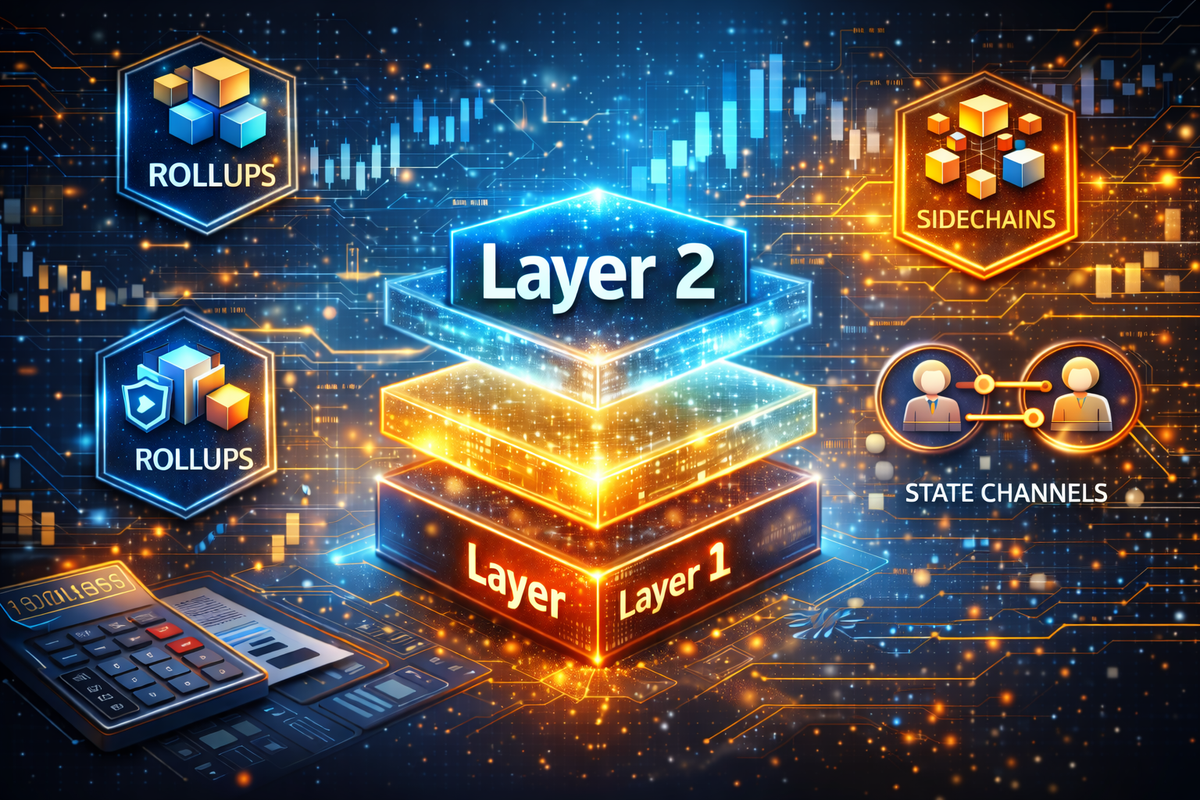
Layer 2 protocols are systems built on top of a Layer 1 blockchain that inherit its security guarantees while executing transactions outside of it. The key insight is that not every transaction needs to be verified by every node in real time. What matters is that the final state — who owns what after all transactions are settled — is correctly recorded on the base layer. Layer 2 networks exploit this distinction aggressively: they process transactions at high speed in a separate execution environment, then periodically submit compressed proofs or summaries of that activity back to Ethereum for final settlement.
The result is a layered financial stack that mirrors, in certain ways, the architecture of traditional finance. Ethereum functions analogously to a central bank settlement layer — the place where final, irrevocable settlement occurs. Layer 2 networks function more like the commercial banking rails that conduct the vast majority of actual economic activity, periodically settling net positions against the underlying reserve layer.
The Technology: Three Approaches to Scaling
Rollups: The Dominant Paradigm
Rollups have emerged as the most widely adopted and institutionally credible approach to Layer 2 scaling, and they now form the backbone of Ethereum's official scaling roadmap. The mechanism is straightforward in concept, though demanding in implementation: transactions are executed off-chain in batches, compressed, and then submitted to Ethereum as a single transaction with a compact proof of their validity. A batch that might represent hundreds or thousands of individual user operations is settled on Ethereum as a single data payload, dramatically reducing the per-transaction cost of Layer 1 security.
There are two dominant variants. Optimistic rollups — exemplified by Arbitrum and Optimism, which together account for the majority of Layer 2 total value locked — operate on a presumption of honesty. Transactions are assumed valid unless a network participant submits a fraud proof within a defined challenge window, typically seven days. This design is relatively simple to implement and highly compatible with existing Ethereum smart contracts, which is why Arbitrum and Optimism attracted developer adoption so rapidly. Coinbase's Base network, which processed over two million transactions per day within months of its 2023 launch, is built on the Optimism stack.
Zero-knowledge rollups take a more mathematically rigorous approach. Rather than relying on the threat of fraud challenges, ZK rollups generate cryptographic validity proofs — called ZK-SNARKs or ZK-STARKs — that mathematically certify the correctness of every batch of transactions before it is submitted to Ethereum. Networks such as zkSync Era, StarkNet, and Polygon's zkEVM have deployed this architecture in production. The advantages are significant: finality is near-immediate rather than delayed by a challenge window, and the security model is purely cryptographic rather than reliant on the presence of honest watchdog participants. The trade-off has historically been implementation complexity and limited compatibility with existing Ethereum tooling, though that gap has narrowed considerably as the technology has matured.
The practical impact on fees has been substantial. Following the activation of EIP-4844 — known as proto-danksharding — in March 2024, which introduced a dedicated data availability lane for rollup submissions, average transaction costs on major Layer 2 networks fell by 80 to 90 percent virtually overnight. Transactions that cost $0.50 to $1.00 on Layer 2 before the upgrade were reduced to fractions of a cent. This single protocol change arguably did more to accelerate Layer 2 adoption than any previous development.
Sidechains: Speed at the Cost of Direct Inheritance
Sidechains represent an older and architecturally distinct approach to the scaling problem. A sidechain is an independent blockchain with its own consensus mechanism and validator set that connects to Ethereum via a two-way bridge. Polygon's Proof-of-Stake chain — the network that onboarded major institutions including Starbucks and Reddit into Web3 applications — is the most prominent example, having processed billions of transactions and accumulated a user base that at its peak rivaled Ethereum mainnet itself.
The critical distinction between sidechains and rollups is where security ultimately derives from. Rollups, by design, inherit Ethereum's security: the validity of every rollup transaction is ultimately guaranteed by Ethereum's consensus. Sidechains do not. A sidechain's security is a function of its own validator set and consensus rules. If those validators collude or are compromised, assets bridged onto the sidechain are at risk in ways that are categorically different from risks on a genuine Layer 2 rollup.
This distinction matters enormously for institutional risk assessment. Bridge hacks — exploits of the smart contracts that lock and unlock assets as they move between chains — have resulted in some of the largest single losses in crypto history. The Ronin bridge hack of 2022, in which attackers compromised validator keys controlling the bridge for the Axie Infinity gaming ecosystem, resulted in a $625 million loss. These risks are not unique to sidechains, but the weaker security inheritance model of sidechain architectures warrants a more cautious approach from investors and protocols managing significant capital.
State Channels: Purpose-Built Throughput
State channels represent the most focused and specialized Layer 2 architecture, designed for specific high-frequency use cases rather than general-purpose smart contract execution. The concept is simple: two or more parties open a channel by locking funds in a smart contract on Layer 1, then transact freely between themselves off-chain, signing each state update cryptographically. Only the final state — the net settlement of all their interactions — is submitted to the base layer when the channel closes.
Bitcoin's Lightning Network is the most widely deployed implementation of this architecture, enabling near-instant, near-free payments between participants with open channels. By 2024, the Lightning Network had accumulated a public channel capacity exceeding $300 million and was being integrated into payment applications serving markets in Latin America and Sub-Saharan Africa, where access to traditional banking infrastructure is limited. For micropayments, streaming payments, and any use case defined by high frequency and low value, state channels remain unmatched in efficiency.
The limitation is structural: state channels require participants to have funds locked for the duration of their channel, are not well-suited to interactions involving parties who have not pre-established a relationship, and offer limited support for complex smart contract interactions. They are a specialized instrument, not a general-purpose scaling solution.
The Investment Landscape: Why Layer 2 Is a Macro Bet
For investors, Layer 2 networks represent a specific thesis: that the value of blockchain execution will increasingly accrue at the Layer 2 level rather than at Layer 1. Ethereum's own roadmap — articulated by founder Vitalik Buterin and formalized in what the developer community calls the "rollup-centric roadmap" — explicitly positions Ethereum's base layer as a settlement and data availability layer, with the expectation that most user-facing activity will migrate to rollups.
The TVL dynamics support this thesis. Combined total value locked across major Ethereum Layer 2 networks crossed $40 billion in 2024, with Arbitrum and Base leading by volume. Transaction counts on Layer 2 networks routinely exceed those on Ethereum mainnet. The user experience gap between Layer 2 and Layer 1 has largely closed: most major DeFi protocols now deploy natively on multiple rollups, and the experience of using Arbitrum or Base is, for most users, indistinguishable from Ethereum except for the dramatically lower fees.
The emergence of Layer 2 networks as distinct economic ecosystems with their own native tokens — Arbitrum's ARB and Optimism's OP being the most prominent — introduces a new class of investment exposure. These tokens represent governance rights over networks processing billions of dollars in transaction volume, and their value is tied to sequencer fee revenue, protocol adoption, and the broader question of how value is distributed across a layered blockchain stack. The interplay between L1 fee burn — Ethereum's EIP-1559 mechanism destroys ETH in proportion to network usage — and L2 sequencer revenue creates a complex but investable set of economic relationships that reward careful structural analysis.
Trade-Offs, Risks, and the Limits of the Architecture
Layer 2 networks are not without genuine risks, and a sophisticated analysis demands that these be addressed with the same rigor applied to the technology's advantages. The most significant concern is fragmentation. The proliferation of Layer 2 networks — there are now dozens of rollups, each with their own liquidity pools, token bridges, and developer ecosystems — creates a landscape where capital and users are distributed across chains that do not natively communicate. Liquidity fragmentation imposes real costs: slippage is higher, capital efficiency is lower, and the user experience of moving assets between networks remains clumsy and, in the case of optimistic rollup withdrawals, slow.
Bridge risk, as discussed in the sidechain context, remains an industry-wide concern. Even rollup bridges, which are more secure than sidechain bridges by design, represent complex smart contract systems that have been the target of sophisticated attacks. The explosion in cross-chain bridging activity has made bridge contracts some of the highest-value targets in the ecosystem, and the history of major bridge exploits argues for significant caution when assessing protocols that depend heavily on cross-chain capital flows.
There is also a more subtle question about the long-term sequencer model. Most major rollup networks currently rely on a single, centralized sequencer — typically operated by the core development team — to order and batch transactions. Centralized sequencers introduce potential points of censorship, front-running, and operational failure. While decentralized sequencer networks are on the roadmap for most major rollups, the timeline for implementation remains uncertain, and the degree to which sequencer centralization undermines the trustlessness that makes these networks valuable in the first place is a question that institutional counterparties are right to examine carefully.
The Bottom Line
Layer 2 networks are not a speculative sideshow to the core Ethereum ecosystem — they are Ethereum's scaling strategy, endorsed by its founders, embedded in its technical roadmap, and increasingly validated by transaction volumes, developer activity, and institutional adoption. The networks that will process the next hundred million users' on-chain financial activity are, with high probability, Layer 2 rollups. The infrastructure is already in production.
For investors, the Layer 2 landscape presents a tiered set of opportunities. At the broadest level, Layer 2 adoption is a direct tailwind for Ethereum itself: more rollup activity generates more demand for ETH as gas for settlement and as the canonical collateral asset of the ecosystem. At a more specific level, the major rollup networks — Arbitrum, Optimism, Base, zkSync, StarkNet — represent distinct bets on different technical architectures, token economic models, and ecosystem development strategies, each with its own risk-adjusted profile.
The more durable insight, however, is structural. The blockchain industry spent years debating whether scalability and decentralization could coexist. Layer 2 networks, and rollups in particular, represent the most credible answer yet produced. They do not resolve the trilemma — no design does — but they push the frontier of what is achievable, bringing Ethereum within range of the throughput required for serious financial infrastructure. For anyone building in this space, or investing in the protocols that are, Layer 2 is not a feature. It is the foundation.


