
Public vs. Private Keys: The Cryptography Behind Crypto
Every blockchain transaction hinges on asymmetric cryptography. Understanding how public and private keys interact is foundational to securing digital assets.
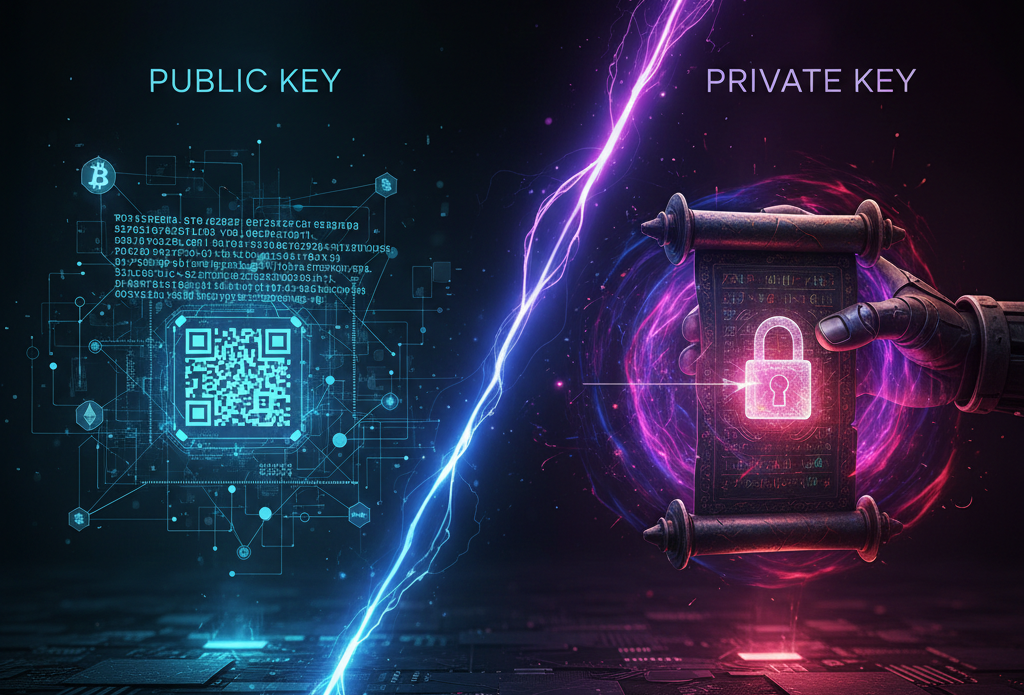
The Invisible Architecture of Ownership
Before a single satoshi changes hands on the Bitcoin network, before an Ethereum smart contract executes a trade, before a stablecoin settlement clears — a cryptographic handshake occurs that most participants never see and fewer still fully understand. Public and private keys are not merely technical abstractions. They are the legal title deed, the vault combination, and the notary stamp of the digital asset economy, compressed into strings of alphanumeric characters that underpin trillions of dollars in value.
The asymmetric cryptography that powers Bitcoin, Ethereum, and virtually every serious blockchain protocol was not invented for finance. It emerged from academic research in the 1970s, most notably the Diffie-Hellman key exchange published in 1976, and was later formalized through RSA encryption. Satoshi Nakamoto's decisive architectural choice was to apply elliptic curve cryptography — specifically the secp256k1 curve — to the problem of digital ownership, creating a system where anyone can verify a transaction without ever knowing the secret that authorized it. That elegance is not incidental. It is the foundation upon which sovereign self-custody rests.
What a Public Key Actually Is
A public key is, in the most precise sense, a point on an elliptic curve. For Bitcoin and Ethereum, that curve is defined by the equation y² = x³ + 7 over a finite field of a prime number approaching 2²⁵⁶. The public key is derived by multiplying a randomly generated private key — a 256-bit integer — by the curve's generator point G, a fixed coordinate specified in the secp256k1 standard. The result is another point on the curve, expressed as a pair of 256-bit integers, which together constitute the uncompressed public key.
In practice, wallets compress this to a 33-byte representation and then hash it twice — first through SHA-256, then through RIPEMD-160 — producing a 20-byte value that, after the addition of a version byte and checksum, becomes the familiar wallet address. A standard Bitcoin address like 1A1zP1eP5QGefi2DMPTfTL5SLmv7DivfNa — the genesis block's coinbase address — is simply a human-readable encoding of this hashed public key.
The critical implication for any investor or institution is this: sharing a public key or wallet address carries no security risk. Publishing it on a corporate treasury disclosure, embedding it in a smart contract, or printing it on an invoice exposes nothing about the underlying secret. The public key is designed to be broadcast. Its entire function is to allow the network — and anyone watching — to verify that a given transaction was authorized by the corresponding private key, without ever revealing what that private key is.
From Public Key to Wallet Address
The distinction between a public key and a wallet address matters more than most introductory materials suggest. MicroStrategy's public treasury addresses, for instance, are wallet addresses derived from public keys — not the public keys themselves. Ethereum's account model works similarly: the 20-byte address displayed on Etherscan is the last 20 bytes of the Keccak-256 hash of the public key. These are one-way transformations. The address cannot be used to reconstruct the public key, and the public key cannot be used to reconstruct the private key. Each layer of hashing adds a redundant security barrier — so that even a theoretical breakthrough against RIPEMD-160, for example, would not immediately compromise the secp256k1 curve itself.
What a Private Key Actually Is
A private key is a 256-bit randomly generated integer — a number between 1 and approximately 1.158 × 10⁷⁷, which is the order of the secp256k1 curve. In hexadecimal form, it appears as a 64-character string. In practice, most institutional and retail wallets represent private keys through BIP-39 mnemonic seed phrases — typically 12 or 24 common English words that encode the same entropy in a format humans can write down and verify without transcription errors.
The private key does precisely one thing: it signs transactions. When a user instructs their wallet to send 1 BTC to another address, the wallet constructs a transaction message containing the inputs, outputs, and amounts, and then produces a digital signature by running that message through the Elliptic Curve Digital Signature Algorithm (ECDSA) using the private key. The resulting signature — two integers commonly referred to as r and s — is appended to the transaction and broadcast to the network.
Possession of the private key is, legally and cryptographically, equivalent to ownership of the associated funds. There is no appeals process, no fraud department, no recovery mechanism beyond custody of the key itself. This is not a flaw in the design. It is the feature. Self-sovereign control of digital assets requires that no third party can freeze, seize, or reverse a properly signed transaction. The corollary is that losing or exposing a private key represents an irreversible loss or transfer of assets. In January 2024, approximately 3.7 million BTC — worth over $200 billion at peak valuations — was estimated to be permanently inaccessible due to lost private keys.
Seed Phrases and Key Derivation
Modern wallets rarely generate a single private key in isolation. BIP-32 hierarchical deterministic (HD) wallets derive an effectively unlimited tree of key pairs from a single root seed, allowing one backup to secure an entire portfolio across multiple blockchains and asset types. The seed itself — generated from the BIP-39 mnemonic — is the master secret. Institutions deploying multi-chain treasury strategies, from BlackRock's tokenized fund infrastructure to Fidelity Digital Assets' custody framework, operate on variants of this architecture. The private key at any branch of the derivation tree can sign transactions for that specific address; the master seed can regenerate the entire tree.
The Digital Signature: How Ownership Is Proven Without Being Revealed
The mechanism by which a private key proves ownership without disclosing itself is among the most consequential cryptographic constructs of the past half-century. ECDSA, the algorithm used by Bitcoin, works as follows: the sender generates an ephemeral random integer k, computes a curve point R = k × G, and uses r (the x-coordinate of R), the transaction hash, and the private key to compute the signature integer s. The verifier — any full node on the Bitcoin network — can then use r, s, the transaction hash, and the public key to confirm that the equation holds, without ever learning the private key or k.
What makes this remarkable in the context of institutional finance is its scalability. The Bitcoin network processes tens of thousands of transactions per day, each one verified by thousands of nodes globally, each verification requiring nothing more than a public key that anyone can freely publish. The computational cost of verification is trivial. The security assumption relies entirely on the hardness of the elliptic curve discrete logarithm problem — specifically, the impossibility of working backwards from the public key point to the private key scalar in any practical timeframe. On the secp256k1 curve, a brute-force attack would require approximately 2¹²⁸ operations, far beyond the capacity of any classical computing infrastructure ever envisioned.
Ethereum's Move Toward Schnorr and BLS
Bitcoin's Taproot upgrade, activated in November 2021, introduced Schnorr signatures as an alternative to ECDSA for certain transaction types. Schnorr signatures offer several advantages for institutional use: they are linearly composable, meaning multiple signers can aggregate their signatures into a single compact proof, reducing on-chain data and enabling more sophisticated multi-party custody schemes. Ethereum's consensus layer already relies on BLS12-381 signatures for validator attestations, enabling the aggregation of thousands of validator signatures into a single 96-byte proof. These architectural evolutions matter to institutions not as abstract cryptography but as direct determinants of transaction fees, custody complexity, and smart contract auditability.
Why This Architecture Matters for Institutional Investors
The public-private key infrastructure is the reason that a hedge fund can publish its cold wallet address for on-chain verification of reported holdings without creating any security risk. It is the reason that tokenized treasury products issued by Franklin Templeton's Benji platform can record ownership on the Stellar blockchain, where every transfer is publicly auditable, while the private keys controlling each account remain secured in institutional custody. Transparency and security are not in tension in this architecture — they are orthogonal properties, guaranteed by mathematical construction rather than policy.
For investors conducting due diligence on digital asset custodians, the operational handling of private keys is the central question. Whether a custodian uses multi-party computation (MPC) — distributing key shares across multiple parties so no single actor ever holds a complete private key — or hardware security modules (HSMs) with air-gapped signing, or threshold signature schemes (TSS) with geographic distribution, every custody model ultimately resolves to a single question: who controls the private key, and under what conditions can it be used to sign a transaction?
The answer to that question determines counterparty risk, liquidation risk, and regulatory exposure more precisely than any contractual arrangement. FTX's collapse in November 2022 demonstrated what happens when private key control is concentrated, opaque, and commingled. Coinbase Custody's regulatory framework, Anchorage Digital's federal bank charter, and Fidelity Digital Assets' institutional offering each represent different institutional architectures for answering that question responsibly.
The Bottom Line
Public and private keys are not passwords in the conventional sense, and understanding the distinction matters enormously for anyone making capital allocation decisions in digital assets. A public key — and the wallet address derived from it — can and should be shared freely. It enables transparency, on-chain auditability, and trustless verification that no traditional financial infrastructure can match. A private key, by contrast, is the unambiguous and irrevocable proof of ownership. It cannot be reset, it cannot be recovered without prior backup, and its compromise is final.
The elliptic curve cryptography underpinning Bitcoin and Ethereum has withstood over fifteen years of adversarial scrutiny from the world's most sophisticated cryptographers, nation-state actors, and well-capitalized research institutions. The security model is not based on obscurity or policy but on mathematical hardness assumptions that are, at present, computationally unassailable by classical means. Post-quantum cryptographic threats remain a long-horizon consideration — both Bitcoin and Ethereum core developers are monitoring NIST's post-quantum standardization process — but they do not represent a near-term operational risk.
For institutional investors, the practical takeaway is straightforward: the cryptography works. The risk lies not in the mathematics but in the operational layer — how keys are generated, stored, backed up, and governed. A $500 million digital asset portfolio secured by a well-implemented MPC custody solution is protected by the same underlying cryptographic guarantees as a single private key stored on a hardware wallet. The sophistication of custody architecture scales the engineering, not the math. Getting that architecture right is the core operational challenge of the digital asset industry, and it begins with understanding exactly what a private key is and why it must be treated as the most sensitive credential in any investor's portfolio.


